Field Notes is drawn from real coaching sessions with law firm founders and managing partners. Details are anonymized. The patterns are not.
Location: Solo practice, estate planning. Mountain West. Founder, 3 years in.
Observation: He already knew everything. That was the problem.
1. The 14-Month Audit
He came to the session having done something unusual. He’d gone back through 14 months of coaching notes, fed them into an AI tool, and asked a hard question: Where am I not progressing?
The answer came back clear. Same four or five themes. Cycling. Over and over. Every time he thought he’d figured something out, the notes showed he’d figured it out once before — and hadn’t acted on it. His words: “I’m mistaking insight for progress.”
Knowledge, by itself, does nothing in the external world. It doesn’t move the needle. It doesn’t close the gap. It doesn’t set the standard. Insight is the beginning of the work, not the work itself.
2. The Conversation He Kept Not Having
Two and a half weeks before the session, he’d built out role and responsibility documents for his staff members. He committed to delivering them. He didn’t.
He called it getting busy. I held up the mirror and called it what it was: avoidance.
After that challenge, the frame shifted for him. The documents weren’t hard. There was nothing punishing in them — no performance improvement plan, no ultimatum. Just clear swim lanes. Who does what. Who’s responsible at which point in the client process.
I asked the obvious question: What’s scary about that?
What surfaced wasn’t about the conversation. It was about the identity underneath it. If he set clear expectations, he became the boss. The guy with authority. The person who holds others accountable. And his whole frame for what that person looks like came from a 60-attorney firm where attorneys threw things at assistants. It came from a CEO who paid himself $600K and reminded his people they were lucky to have jobs.
He’d spent years sprinting away from those models. So hard, so fast, that he’d never built a model of his own.
3. The Architecture Problem
He knew his team wanted direction. He said it plainly: “They want to help me succeed. They just don’t know how.”
One team member had a two-hour arrival window each morning. Not because she was unreliable — because he’d never told her when to arrive. Another team member sent emails with typos — not because she didn’t care, but because no standard had been set. Filing errors were costing him $150 a week in duplicate court fees — not because of incompetence, but because there was no process.
He’d built a firm without a rudder and was frustrated the boat wasn’t going straight.
This is an architecture problem, not a people problem. And the architecture stays broken until the founder decides — consciously, deliberately — what kind of CEO he’s going to be. Not the tyrant. Not the martyr who suffers in silence. Something he has to name and build for himself.
4. The Linchpin
Near the end of the session, I asked him: “If you could unlock one thing — one thing that could affect everything else — what would it be?” He didn’t hesitate: “Self-confidence.”
And then the deep work began. Because I asked him to finish a sentence — Because I am more confident, my team… — and the self-editing started immediately. The sentence kept stalling. Because building the confident CEO version of himself felt like becoming someone he’d decided not to be.
Here’s what’s true: demanding and kind are not opposites. Clarity is an act of respect. Standards are a form of care. The founders who suffer in silence aren’t protecting their people — they’re protecting themselves from the discomfort of leading.
He left with three action steps. Read his Vivid Vision with a beginner’s mind. Identify one successful person he actually respects. Have the conversations he’d been avoiding — because he was prepared, and his team was waiting.
The Bottom Line
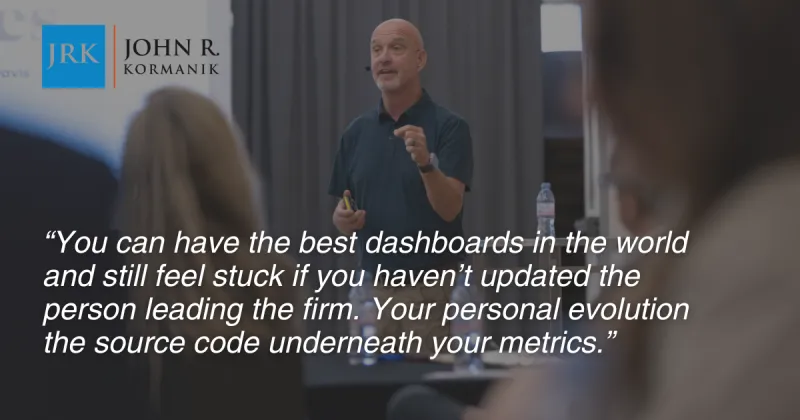
Fourteen months of insight hadn’t moved the needle. Not because the insight was wrong. Because insight, without action, is just a very expensive journal.
The cognitive architecture that keeps founders stuck is rarely about not knowing. It’s about the stories they tell about what it means to lead — where those stories came from, and whether they’ve ever questioned them.
Field Exercise
-
Where in your firm are you tolerating something you’ve never named out loud — to yourself or to your team?
-
Think of the leaders in your past who shaped your picture of boss. Are you leading toward that picture, or away from it? And is either direction actually working?
-
What insight have you had more than once — something you’ve “figured out” before — that you still haven’t acted on?
Insight is the beginning. The work is what comes after.
Ready to stop cycling and start building? Click below to schedule a private, 1:1 converstation.