Case Study: Insight Without Action Is Keeping Your Law Firm Stuck

Field Notes is drawn from real coaching sessions with law firm founders and managing partners. Details are anonymized. The patterns are not.

Location: Solo practice, estate planning. Mountain West. Founder, 3 years in.

Observation: He already knew everything. That was the problem.

1. The 14-Month Audit

He came to the session having done something unusual. He’d gone back through 14 months of coaching notes, fed them into an AI tool, and asked a hard question: Where am I not progressing?

The answer came back clear. Same four or five themes. Cycling. Over and over. Every time he thought he’d figured something out, the notes showed he’d figured it out once before — and hadn’t acted on it. His words: “I’m mistaking insight for progress.”

Knowledge, by itself, does nothing in the external world. It doesn’t move the needle. It doesn’t close the gap. It doesn’t set the standard. Insight is the beginning of the work, not the work itself.

2. The Conversation He Kept Not Having

Two and a half weeks before the session, he’d built out role and responsibility documents for his staff members. He committed to delivering them. He didn’t.

He called it getting busy. I held up the mirror and called it what it was: avoidance.

After that challenge, the frame shifted for him. The documents weren’t hard. There was nothing punishing in them — no performance improvement plan, no ultimatum. Just clear swim lanes. Who does what. Who’s responsible at which point in the client process.

I asked the obvious question: What’s scary about that?

What surfaced wasn’t about the conversation. It was about the identity underneath it. If he set clear expectations, he became the boss. The guy with authority. The person who holds others accountable. And his whole frame for what that person looks like came from a 60-attorney firm where attorneys threw things at assistants. It came from a CEO who paid himself $600K and reminded his people they were lucky to have jobs.

He’d spent years sprinting away from those models. So hard, so fast, that he’d never built a model of his own.

3. The Architecture Problem

He knew his team wanted direction. He said it plainly: “They want to help me succeed. They just don’t know how.”

One team member had a two-hour arrival window each morning. Not because she was unreliable — because he’d never told her when to arrive. Another team member sent emails with typos — not because she didn’t care, but because no standard had been set. Filing errors were costing him $150 a week in duplicate court fees — not because of incompetence, but because there was no process.

He’d built a firm without a rudder and was frustrated the boat wasn’t going straight.

This is an architecture problem, not a people problem. And the architecture stays broken until the founder decides — consciously, deliberately — what kind of CEO he’s going to be. Not the tyrant. Not the martyr who suffers in silence. Something he has to name and build for himself.

4. The Linchpin

Near the end of the session, I asked him: “If you could unlock one thing — one thing that could affect everything else — what would it be?” He didn’t hesitate: “Self-confidence.”

And then the deep work began. Because I asked him to finish a sentence — Because I am more confident, my team… — and the self-editing started immediately. The sentence kept stalling. Because building the confident CEO version of himself felt like becoming someone he’d decided not to be.

Here’s what’s true: demanding and kind are not opposites. Clarity is an act of respect. Standards are a form of care. The founders who suffer in silence aren’t protecting their people — they’re protecting themselves from the discomfort of leading.

He left with three action steps. Read his Vivid Vision with a beginner’s mind. Identify one successful person he actually respects. Have the conversations he’d been avoiding — because he was prepared, and his team was waiting.

The Bottom Line

Fourteen months of insight hadn’t moved the needle. Not because the insight was wrong. Because insight, without action, is just a very expensive journal.

The cognitive architecture that keeps founders stuck is rarely about not knowing. It’s about the stories they tell about what it means to lead — where those stories came from, and whether they’ve ever questioned them.

Field Exercise

  1. Where in your firm are you tolerating something you’ve never named out loud — to yourself or to your team?

  2. Think of the leaders in your past who shaped your picture of boss. Are you leading toward that picture, or away from it? And is either direction actually working?

  3. What insight have you had more than once — something you’ve “figured out” before — that you still haven’t acted on?

Insight is the beginning. The work is what comes after.

Ready to stop cycling and start building? Click below to schedule a private, 1:1 converstation.

Ready to stop building your firm around what you're afraid of?

If this article has allowed you to see something differently about your time, leadership, or role inside the firm, a Private 1:1 Conversation is a simple next step.

SCHEDULE A PRIVATE 1:1 CONVERSATIONTAKE THE FOUNDER-TO-CEO ASSESSMENT

Case studies

Case Study: Insight Without Action Is Keeping Your Law Firm Stuck

Case Study: Insight Without Action Is Keeping Your Law Firm Stuck

Field Notes is drawn from real coaching sessions with law firm founders and managing partners. Details are anonymized. The patterns are not.

Location: Solo practice, estate planning. Mountain West. Founder, 3 years in.

Observation: He already knew everything. That was the problem.

1. The 14-Month Audit

He came to the session having done something unusual. He’d gone back through 14 months of coaching notes, fed them into an AI tool, and asked a hard question: Where am I not progressing?

The answer came back clear. Same four or five themes. Cycling. Over and over. Every time he thought he’d figured something out, the notes showed he’d figured it out once before — and hadn’t acted on it. His words: “I’m mistaking insight for progress.”

Knowledge, by itself, does nothing in the external world. It doesn’t move the needle. It doesn’t close the gap. It doesn’t set the standard. Insight is the beginning of the work, not the work itself.

2. The Conversation He Kept Not Having

Two and a half weeks before the session, he’d built out role and responsibility documents for his staff members. He committed to delivering them. He didn’t.

He called it getting busy. I held up the mirror and called it what it was: avoidance.

After that challenge, the frame shifted for him. The documents weren’t hard. There was nothing punishing in them — no performance improvement plan, no ultimatum. Just clear swim lanes. Who does what. Who’s responsible at which point in the client process.

I asked the obvious question: What’s scary about that?

What surfaced wasn’t about the conversation. It was about the identity underneath it. If he set clear expectations, he became the boss. The guy with authority. The person who holds others accountable. And his whole frame for what that person looks like came from a 60-attorney firm where attorneys threw things at assistants. It came from a CEO who paid himself $600K and reminded his people they were lucky to have jobs.

He’d spent years sprinting away from those models. So hard, so fast, that he’d never built a model of his own.

3. The Architecture Problem

He knew his team wanted direction. He said it plainly: “They want to help me succeed. They just don’t know how.”

One team member had a two-hour arrival window each morning. Not because she was unreliable — because he’d never told her when to arrive. Another team member sent emails with typos — not because she didn’t care, but because no standard had been set. Filing errors were costing him $150 a week in duplicate court fees — not because of incompetence, but because there was no process.

He’d built a firm without a rudder and was frustrated the boat wasn’t going straight.

This is an architecture problem, not a people problem. And the architecture stays broken until the founder decides — consciously, deliberately — what kind of CEO he’s going to be. Not the tyrant. Not the martyr who suffers in silence. Something he has to name and build for himself.

4. The Linchpin

Near the end of the session, I asked him: “If you could unlock one thing — one thing that could affect everything else — what would it be?” He didn’t hesitate: “Self-confidence.”

And then the deep work began. Because I asked him to finish a sentence — Because I am more confident, my team… — and the self-editing started immediately. The sentence kept stalling. Because building the confident CEO version of himself felt like becoming someone he’d decided not to be.

Here’s what’s true: demanding and kind are not opposites. Clarity is an act of respect. Standards are a form of care. The founders who suffer in silence aren’t protecting their people — they’re protecting themselves from the discomfort of leading.

He left with three action steps. Read his Vivid Vision with a beginner’s mind. Identify one successful person he actually respects. Have the conversations he’d been avoiding — because he was prepared, and his team was waiting.

The Bottom Line

Fourteen months of insight hadn’t moved the needle. Not because the insight was wrong. Because insight, without action, is just a very expensive journal.

The cognitive architecture that keeps founders stuck is rarely about not knowing. It’s about the stories they tell about what it means to lead — where those stories came from, and whether they’ve ever questioned them.

Field Exercise

  1. Where in your firm are you tolerating something you’ve never named out loud — to yourself or to your team?

  2. Think of the leaders in your past who shaped your picture of boss. Are you leading toward that picture, or away from it? And is either direction actually working?

  3. What insight have you had more than once — something you’ve “figured out” before — that you still haven’t acted on?

Insight is the beginning. The work is what comes after.

Ready to stop cycling and start building? Click below to schedule a private, 1:1 converstation.

Read more
Case Study: Why Putting It on Your Calendar Won’t Work

Case Study: Why Putting It on Your Calendar Won’t Work

Inspired by my Kenyan safari, “Field Notes” are my observations from the field where my clients and I work — coaching sessions. Each field note is drawn from actual client sessions and gives insight into the personal evolution of my clients.

Location: A Litigation Firm Founder’s Office, Midwest

Observation: The thing you’re not doing isn’t a scheduling problem. It’s a thinking architecture problem.

He’d done the reading. He’d had the insight. He knew exactly what needed to happen next; a Vivid Vision for the firm, dedicated CEO time, a shift from practicing lawyer to firm leader.

He just hadn’t done any of it.

His explanation: he needed to put it on his calendar.

That’s not the issue.

1. The Architecture Under the Avoidance

When a founder tells me they haven’t scheduled something important, I don’t accept that at face value. So we dug.

Why wasn’t he doing CEO time? It doesn’t feel like work.

Why hadn’t he started the Vivid Vision? It seems lazy. Kind of selfish.

Why selfish? If I’m thinking, I’m not doing. If I’m not doing, I’m not earning my keep.

There it is. The thinking he most needs to do, he has classified as not-working. The identity he needs to grow into (visionary, strategist, communicator, leader) he’s treating as optional. Until you see that belief clearly, you can’t upgrade it. The calendar is just a symptom.

2. Goal Mindset vs. Mastery Mindset

He was frustrated after two depositions where witnesses refused to give him direct admissions. He wanted tools to force the outcome.

I asked a different question: What if the outcome isn’t yours to control?

He’d been thinking about Kobe. Not winning games just getting better at what he did. Kobe couldn’t control the other 12 people on the floor (9 other players and 3 officials). He controlled his own mastery.

That’s the distinction. The goal mindset is anchored to the outcome and when it doesn’t come, you’re thrown. The mastery mindset is anchored to the process, and no witness, opposing counsel, or obstinate team member can touch that.

Those depositions weren’t just a technique problem. They were a live demonstration of the cognitive pattern running his firm: over-indexing on what he can’t control, underinvesting in what he can.

3. The Three Levels You Have to Work Through

We went three levels deep on what he needed to become for CEO time to be real.

Level one: recognize that thinking is productive work, likely your highest-leverage work.

Level two: reframe the thinking-doing binary. Both are tools. Deploy them in the right context.

Level three: the one that matters most: get comfortable wanting what you want. Stop treating your own vision as selfish.

That’s where most founders get stuck. Not weakness. Years of building an identity around service, hustle, and sacrifice. Wanting a firm that runs without them can feel wrong before it feels right.

4. What the Upgraded Architecture Looks Like

When the belief architecture shifts, CEO time stops feeling like avoidance and starts functioning like strategy.

The founder shows up to that blocked hour knowing his job is not to answer emails or close cases. His job is to ensure the Vivid Vision becomes reality. That reframe changes everything: what he works on, how he delegates, what he tolerates, what he builds.

He stops asking did I get the admission? and starts asking did I deploy the right tools with full command? He stops measuring his value by what he produces in a day and starts measuring it by what the firm produces without him in the room.

The thinking-doing binary dissolves. Strategic thinking is doing at the highest level available to a founder. Silence in a deposition becomes a tool, not a void. A Vivid Vision becomes a job requirement, not a luxury.

That’s the upgraded architecture. It’s not a personality transplant. It’s a decision to redefine what work means and then build your calendar, your team, and your firm around that definition.

The Bottom Line

Calendaring CEO time is not the problem. The belief architecture underneath it is. Until a founder gets comfortable with the idea that their thinking is their most important work — and that having a clear vision for their firm is not a luxury, it’s their job — no amount of scheduling will stick.

Avoidance is never about time. It’s always about something deeper.

Field Exercise

  1. What have you been calling a scheduling problem that might actually be a belief problem?

  2. Where in your firm are you anchored to outcomes you don’t control and losing energy because of it?

  3. What would it mean for your leadership if you adopted a mastery mindset instead of a goal mindset in the next 90 days?

The founder who can answer those questions honestly (and sit with the discomfort of the answers) is the founder building something that lasts.

End of dispatch.

Ready to upgrade the cognitive architecture that drives your firm? Schedule a 1:1 Conversation.

Read more
Case Study: How One Law Firm CEO Broke Through Limiting Beliefs With Executive Coaching

Case Study: How One Law Firm CEO Broke Through Limiting Beliefs With Executive Coaching

“When you challenged my thinking by asking why I was thinking so small, it hurt.” Is this statement positive or negative?

One of the many reasons to work with me as your executive coach is to gain a fresh perspective—a perspective that challenges you to see when you’re holding yourself back from reaching your full potential. The saying goes: You can’t read the ingredients on the cereal box from the inside. In other words, you often can’t recognize the limits of your mindset when you’re “in it.” A recent coaching session with a law firm CEO offered a vivid reminder of this truth.

To tell this client’s story, a bit of background is needed. My client is the CEO of a successful personal injury law firm in the Mid-Atlantic U.S. He and I began working together a few years ago when he was at a pivotal point in his business journey—stepping into his role as CEO and building his team. After some time, he “graduated” from coaching. All coaching relationships have a beginning, middle, and end. He had reached a point where he was ready to execute his new CEO mindset independently. Watching clients “take off” is a proud moment for them and for me.

Once you’re a client, you’re always part of the team. As is my habit, I stayed in touch with him. During one of our check-ins, he mentioned he was ready to reengage with executive coaching; he’d maxed out his mindset at his then-current level and wanted to evolve further. My first step was to see if he was thinking big enough to make our coaching sessions impactful. Without that, the investment of time and money wouldn’t be worthwhile.

I asked him where he saw his next level of growth. A straightforward way to measure this is by gross revenue—a metric that, for many attorneys and law firm leaders, is linked to personal growth and mindset transformation. When he shared his revenue goal for the end of our 12-month coaching engagement, the number struck me as uninspiring. It would require no real personal evolution—just increased business efficiencies. So I asked, “Why are you thinking so small?”

He was taken aback. “John, that’s not small!” I told him that if that was the goal, it wouldn’t be worth his time or money to work with me. He and his team could grind harder and get there without executive coaching. I let the silence linger; he was clearly thinking. As a law firm CEO, few people challenged him like this.

I repeated, “Why are you thinking so small?” This time, I added, “What if you couldn’t fail? What would the number be then?” He then shared a figure ten times higher than his initial goal. I asked, “What shifted to make you believe that level of revenue is achievable?” His response was pure gold: “If I couldn’t fail, I’d be a lot more confident in going big.”

My next question was, “Who would you need to become to achieve that goal?” His answer was equally profound: “I’d have to be someone entirely different than I am today. My leadership, communication, and performance would all have to evolve.” With this new goal and an understanding that personal growth would be essential, we agreed to move forward together.

Flash forward six months.

In a recent coaching session, we discussed a crucial leadership skill all managing partners and law firm owners must master: saying no to a thousand things. He paused and revisited the initial conversation, saying, “When you challenged my thinking by asking why I was thinking so small, it hurt.” I asked why. He replied, “It hurt because I’ve never thought of myself as someone who thinks small. I was trapped in my own thinking, and without you challenging me, I would never have realized it.”

Working with me as your executive coach isn’t comfortable—and it’s not meant to be. Comfort is for those who are satisfied with the status quo, content with “good enough.” Growth occurs when we move through discomfort.

My clients are the best attorneys in their fields. They’re managing partners and law firm CEOs who are comfortable with being uncomfortable, who think big to keep their firms thriving. They increase revenue, master their time and focus, improve performance, and ultimately enjoy more freedom with less burnout. You can too. Schedule a complimentary 30-minute discovery session with me, or send me an email.

Read more
Case Study: Stepping Off the Hamster Wheel

Case Study: Stepping Off the Hamster Wheel

High achievers, aka the outstanding attorneys who invest in themselves and enter a coaching relationship with me, are like perpetual-motion machines. Always doing; always on to the next thing. Never satisfied; never stopping. Their constant motion gets sh#t done. It has led to their success. As with all things though, there’s a “dark side” to the skill, habit, compunction, or whatever you wish to call it.

During a recent exit interview (remember, all coaching relationships have a beginning, middle, and end) I asked my graduating client to identify the greatest insight he had gained from our year-long coaching engagement. His answer: “Coaching built my ability to be intentional and reflective.” Let’s dive into why reflective time is critical for outstanding attorneys.

The Pitfalls of Constant Motion for High-Achieving Attorneys.

All the attorneys I work with are outstanding practitioners (they wouldn’t seek me out to team up with if they weren’t). Just think about the amount of client work you’ve done over the past month! Although you may perceive you struggle with focus (the statistics on time worked and time billed would back you up) or the mythical unicorn of “balance,” (which, in my humble opinion is bullsh#t), you nevertheless get the lion’s share of your work done. Kudos! Getting your legal work done is the only way to keep client’s satisfied and the lights on. There is a downside to the “nose to the grindstone” mentality. There are drawbacks to following the lie “if I’m not busy, I’m lazy.”

Why Intentional Reflection is Crucial for Attorneys.

Continuously moving forward, whether it be in case work, networking to create robust referral partners, speaking engagements, or whatever other activities you have on your calendar to fill your days has its benefits, of course. It is the “doing” of things that, well, gets things done. Outstanding lawyers are skilled at putting their heads down and achieving audacious goals. It’s how they’ve become successful by many metrics their firm may require or society measures them by.

The Myth of Productivity: How Busyness Can Hold You Back.

Head down and the constant focus on completing tasks, however, has a dark side. You’re so focused on knocking out tasks and moving on to the next thing that you lose sight of the bigger picture. Sure, you’re getting things done, but at what cost? Strategic thinking, creativity, and long-term planning all require space—mental space that you simply don’t have when you’re caught up in the daily grind. This relentless drive, while it’s gotten you where you are, can actually be the very thing holding you back from where you want to go. It’s the trap of thinking that busyness equals productivity, when in reality, it’s a recipe for burnout and missed opportunities.

Structured vs. Unstructured Thinking: The Key to Your Success.

This is where intentional reflection comes into play. If you’re constantly in motion, you’re missing out on the opportunity to step back, reassess, and ensure that your actions are aligned with your long-term goals. Taking the time to pause and think—not just about what’s on your to-do list, but about where you want to go—creates the mental clarity and strategic insight that busy work alone can’t provide. It’s in these quiet moments of reflection that true innovation and progress happen. That’s why I encourage my clients to carve out dedicated time for thinking—both structured and unstructured.

How “Shower Thoughts” Lead to Breakthrough Insights.

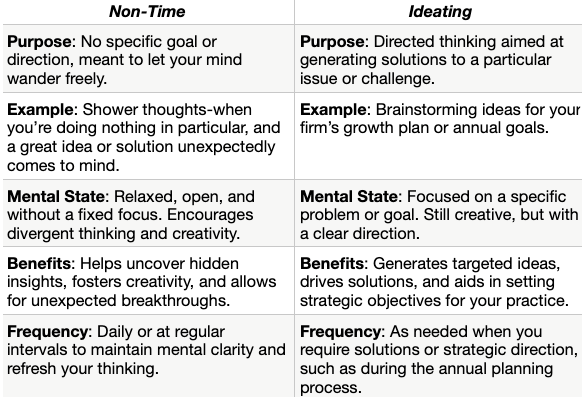
There are two types of non-structured thinking time my clients perform; non-time (unstructured) and ideating (structured). Although they are both time dedicated to thinking, they are quite different. Non-time has no direction at all, think “mind wandering.” Ideating, on the other hand, has a direction, think the beginning of the annual planning process. “Where do I want my firm to be by the end of next year?”

Non-time results in shower thoughts. An article in the Washington Post takes a look at the phenomena of “shower thoughts” and creativity. Time dedicated to allowing your mind to wander is simply that. It is free time on your calendar for you to do nothing but allow ideas to flow through your mind. Have you ever been in the shower, or on a walk, thinking about absolutely nothing, and discovered the solution to a problem that was befuddling you? That’s a shower thought. Is such time billable? Maybe. Is it essential to your law practice? Definitely.

Creativity is a Lawyer’s Secret Weapon.

Before you say “But John, I’m a lawyer, not a creative!” Don’t. Just. Don’t.

Of course you’re a creative. If you’re not, who is setting the vision for your law firm or law practice? Who creates novel legal arguments, sometimes out of whole cloth? Who creates the proper environment to bring the buyer and seller to the conclusion of an M&A deal? I’ll tell you who…you! You are a creative, so cut the nonsense.

The Einstein and Steve Jobs Approach to Boosting Creativity. 

An Inc. article discusses how two giants used non-time as a way to boost their creativity. Albert Einstein insisted some of his best ideas came to him while he was sailing (not very well according to his biographers) and not focused on anything in particular. Steve Jobs too allowed himself to have blocks of non-time in his schedule where he would simply permit divergent ideas come to him (iPod, anyone?). Tell me you’re less of a creative than Einstein or Jobs and we’ll have a discussion about why you believe that to be so.

Non-Time vs. Ideating: Two Critical Tools for Attorneys.

The second type of unstructured time, ideating, is different, but no less critical. Ideating is the process of generating ideas and solutions to a specific issue or challenge. Because there is a prompt that directs your thinking, your mind is not totally free to wander and, instead, is targeted. Ideating is brainstorming. It is iterative and time limited. It ought not drag on and on but, instead, has a defined beginning and end. Creating the vision for your firm or practice is ideating. Creating the AIM (acceptable, ideal, middle) of an annual revenue or networking SMART goal is ideating. Critical tasks required for any successful law practice.

As a successful attorney, you’re no stranger to structured time, but when it comes to reflection and creativity, many lawyers don’t realize there are different ways to approach it. That’s why I encourage my clients to dedicate time to two distinct forms of unstructured thinking: non-time and ideating. Both are essential, but they serve different purposes and yield different results. To help clarify, here’s a breakdown of the two approaches:

Non-Time vs. Ideating: A Side-by-Side Comparison

From Chaos to Clarity: The Impact of Reflection on Performance.

When my client first came to me, he was all about the doing of the work. His ability to step off the hamster wheel, pick up his eyes and look at the proverbial horizon, needed work. When we first came to work together, he couldn’t see the value of stepping back. By working with me, slowly and surely over our 12-month engagement, he came not only to see the value, but experience it first hand. His life, and his practice changed, his revenue increased, the quality of his work product leveled up, his clients were more satisfied, and his days were not nearly as hectic or frantic despite the fact he set aside daily non-time and ideation time.

Increase Revenue, Master Time, Reduce Burnout – Get a Coach.

Neither Einstein nor Jobs had their heads in the clouds all the time. We know from them, however, such time is critical. When they were done, they got to work, which, as I said, is necessary to succeed. After all, both Einstein and Jobs did the work after they thought of the stuff.

My clients are the best attorneys in their field. They increase revenue, master their time and focus, and improve performance while enjoying more free time and suffering less burnout. You can too. Schedule a complimentary 30-minute discovery session with me, or send me an email.

Read more
Case Study: Leveraging Discomfort for Growth

Case Study: Leveraging Discomfort for Growth

I coach high-achieving attorneys around the globe. One of the best ways to ensure my clients continue to grow and avoid stagnation is to empower them to think differently about success, stagnation, and comfort. Leveraging the power and clarity of a Likert scale, we explore their current state. When my clients reach an 8, 9, or 😅 10 out of 10 on the scale, it’s time to add some spice 🌶️ to the mix. I’ll break down a discussion from a recent coaching session to demonstrate what I mean and how my client was able to move forward.

Understanding the Comfort Zone: Why Success Leads to Stagnation. 

My client is an outstanding attorney who has a process for leveraging a task list to get work done. When I asked her why she believes a task list empowers her to be productive, the first thing she said was, “You’ll probably tell me this isn’t the right thing to do,” and then described her process. My response: “I don’t really care what ‘they’ say is right or wrong. What I want to know is whether this system works for you! Please don’t get bogged down in what you believe others believe!”

Getting on the Same Page: The Power of the Likert Scale.

After discussing this concept, we got down to the nitty-gritty. I asked, “On a scale of 1-10, with 10 being supremely comfortable with the process and 1 being not comfortable at all, where do you rate yourself?” After a pause, she shared that she was very comfortable, “an 8 or 9 out of 10.” We explored why she had that comfort level. The primary driver was that she’d been creating a task list and leveraging it for years. A list created clarity for her, gave her the ability to see what needed to be done, and allowed her to classify things as “A” tasks (heavy lifts requiring cognitive engagement) and “B” tasks (simple things requiring little if any cognitive load). Of course, her process wasn’t as simple as a list of to-dos. When we drilled down, she performed mental work outside the list itself to prioritize and move forward.

Challenging the Status Quo: Comfort is a Barrier to Growth.

Next, I challenged her. When we get to an 8, 9, or 10 out of 10 with a process or a system, high achievers like her must explore iterating the process to enable continued growth. Human beings are generally lazy (just look at any retired athlete). When we land on a solution to our “problem,” we take it and think, “Well, that’s it.” But here’s the thing: just because it works and takes away our pain in the moment doesn’t mean it’s optimized. In other words, the solution we came up with is, in fact, the bare minimum necessary to solve our issue.

Implementing Change: Doing the Thing That Causes Stress.

I asked, “How can you add to or change your process so that your comfort level decreases in the short term, but the process actually works better for you in the long run?” Her response was immediate (🤔 which meant she’d been thinking of this before we ever began our exploration): “It’s a pain in the ass…but I could invest time on the front end, review my list, select my ‘A’ tasks, and ensure I have everything necessary to do deep work on them without having to stop and gather additional materials.”

Overcoming Resistance: The Role of Delay Discounting in Professional Growth. 

The obvious question: “What makes it a pain in the ass?” Her response was classic delay discounting. In my client’s case, the instant gratification of doing the work outweighed the reality that investing time on the front end to properly prepare for the work would result in her being more efficient in the future. Once that door was open, she stopped and thought. She was transported to a different time. I allowed her to take the mental journey.

She then shared a memory, recalling how, “in the old days,” she’d gather law books, have them open and at the ready, in the order she wanted them, and then begin writing. (Yes, I remember those days…I Shepardized in Shepard’s books in the law library.) She’d gotten away from that process, and upon reflection, she realized she spent less time in flow (deep work and concentration) because she wasn’t actually prepared to do the work.

Embracing Discomfort: Iteration Leads to Long-Term Success.

I then asked how uncomfortable adding this step would be and what she would imagine rating the process with that “pain in the ass” pre-work. She responded, “6 or 7 out of 10.” My response: “Great!” She looked at me as if I had three heads.

“Isn’t that going backwards?” she asked. “Why would I willingly move from an 8 or 9 out of 10 backward?”

“Because, in order to grow, we must iterate. Iteration is uncomfortable in the short term. That discomfort is a necessary predicate to growth. By adding this ‘pain in the ass’ step, you may very well end up with a process that serves you better than your current one.”

She agreed to do the pre-work with her list. We’ll explore it at our next session.

Conclusion: You Must Leveraging Discomfort for Professional Growth. 

If she leans all the way in and if it has the potential to make her process more effective, we’ll leverage the metrics function of her coaching dashboard to build the habit of completing the new step consistently.

Sometimes we have to take a perceived step “backwards” to move forward past complacency and stagnation.

Where do you believe you’re doing well? Is it time to change the frame and ask, “Is good enough, good enough?”

My clients are the best attorneys in their field. They increase revenue, master their time and focus, and improve performance while enjoying more free time and suffering less burnout. You can too.Schedule a complementary 30-minute discovery session with me here, or send me an email.

Read more
Case Study: Getting Unstuck

Case Study: Getting Unstuck

One of the conditions I see repeatedly in the beginning of many of my coaching engagements is, what I call “stuckness.” This condition has a host of symptoms: failure to take advantage of the right opportunities when they reveal themselves; grasping at shiny objects which, in fact, do not move my client or their business forward in a meaningful way; shying away from their worth as an advocate and human being, just to name a few. Many believe being stuck is the failure to take action. This isn’t so. Stuckness is both the failure to engage in necessary action and engaging in the incorrect actions for achieving your goals.

Meet J.S, an outstanding attorney who teamed up with me to get him unstuck, focused on the things he needed to do to achieve his big vision, and to grow his firm’s bottom line. It is important to know, also, J.S. is a trial lawyer, as opposed to a mere litigator. He loves being in the arena; he loves the combat and the scoreboard; he loves to win on behalf of his clients, his firm, and himself.

Getting to Go.

When J.S. and I first explored working together some 2+ years ago, he wasn’t ready to hear what I had to say. We went through the exploration portion of my discovery process and, honestly, J.S. wasn’t willing to recognize what ailed him. As I mentioned, he’s a trial lawyer and, so, his ego was strong and the armor he wore quite thick.

The discovery portion of my process with potential clients is to determine whether I’m a good fit for them and they’re a good fit for me. It is not window dressing. It is meaningful. I do not offer to coach everyone who wants (or thinks they want) me on their team. I am very particular. My potential clients are very particular. That is how it ought to be.

Late last year, J.S. realized he wasn’t going to be able to achieve his goals without a seasoned guide. He reached out. This time, during the discovery process, it became readily apparent he was ready. We engaged.

A Stuck Mindset.

J.S. identified big goals during the portion of my coaching framework known as “Roots.” He had had the goals for quite a while; he simply was stuck and not moving forward. He said he wanted to achieve the goals. In fact, he was an 8/10 committed to goal achievement. The final two points was his what was holding him back not only as the CEO of his law firm, but other important areas of his life. I knew he needed a quick win or two to get him unstuck and to move forward. Honestly, J.S. had more than a bit of trepidation and angst when I caused him to be stretched beyond his comfort zone. The thing is, without getting uncomfortable, no one can ever move forward.

Not only was J.S. not moving forward, he was down on himself for not doing so. Such a mindset did nothing but cause him to experience stress. As we know, stress begets stress. We can’t see a clear path out and, so, we simply spiral and stay stuck.

The One Thing That Changed Everything: Increased Confidence.

When we first teamed up, J.S. let me know he was going to “have” to get out of three of his current cases because the clients were not paying their legal bills. When I told him it was 100% his doing, he pushed back and then got curious. I let him know, first and foremost, he was not alone. The condition plagues more law firms than you can count. The reason he was going to have to withdraw from those relationships was a lack of confidence in setting appropriate retainers. On the one hand he wanted to serve, on the other hand he failed to set the clients up for a successful engagement because he did not have the confidence to demand (yes, demand) a retainer in the amount consummate with the complexity of the matter he was taking on.

J.S. is a trial lawyer. You’d believe he exuded confidence everywhere. Not so. He was extremely confident in the arena which is the courtroom. His confidence wained when it came to his value and his ability to draw clients who understood that value and would be more than happy to compensate him appropriately from the initial retainer to payment of the monthly bills.

After six weeks of working with me, J.S. demanded his highest retainer ever. He showed up confidently and had a “take it or leave it” mindset because he understood what the representation was going to entail and no longer was willing to settle for less. The client didn’t blink an eye. The client wired the funds.

In another matter, J.S. again demanded the retainer which, in his professional judgment, was required. This potential client balked. Because of his confidence, J.S. didn’t budge and allowed the client to walk.

J.S.’s motto is “excellent representation at a fair price.” He has conversations with potential clients with this motto in mind. He now has a roster of clients he truly enjoys working with.

When we discussed this change, here’s what he said: “I knew I ought to set retainers at the correct level. I had lost my way and made some incorrect decisions because I love to serve others. Now, I’m back!”

Virtually all attorneys get into the business of the law to serve. The thing to remember is service includes serving others in ways to ensure they don’t lose sleep during our representation. It also includes serving ourselves and our businesses. When we don’t no one wins.

My clients are the best attorneys in their field. They increase revenue, master their time and focus, and improve performance while enjoying more free time and suffering less burnout. You can too. Schedule a complementary 30-minute discovery session with me here, or send me an email.

Read more
Case Study: A Shifted Mindset: What If It’s Possible?

Case Study: A Shifted Mindset: What If It’s Possible?

A shifted mindset makes all the difference.

Let’s be 💯. When we don’t think something is achievable, it is virtually impossible to fully commit to the work necessary to achieve that thing. Once we shift from a “can’t be done” to “what if it’s possible” mindset, the possibilities we can imagine are virtually endless. Once we come to this understanding and, more importantly, are able to not only accept it, but lean fully into it, we create clarity of action our competition lacks. That means we’ll generate results, including a full marketing pipeline with high-quality prospects and a increase in revenue. A recent client success is proof-positive of this reality.

The Complicated Life of a Lawyer with Multiple Priorities.

A bit of background. My client “Daryl’s” primary motivation for working with me was to do all he could to hit his gross income target. (Yes, many attorneys work with me with this primary objective in mind.) Of course, “making your number” requires much more than you might believe. First and foremost, it requires focus, dedication, and clarity.

One of the areas Daryl and I are focused on is leveraging networking opportunities to create relationships which will result in referred business. Daryl (and, likely you) know it is important to invest time in client creation which has a high potential for a return. After all, there are so many things calling for you to spend your time, time becomes the limiting factor.

During a recent coaching session, Daryl committed to continuing investing his time in one of the organizations he believed, after a thorough analysis guided by me, would be a high-impact space for him to network. In response to my question about how dedicated he was to playing full out, and what that looked like for him from the perspective of goal setting, Daryl responded with a bit of a narrative in the middle of which he said something that caught my attention: “I will play full out … as much as I can.” Of course, after allowing Daryl to finish his narrative, I prompted: “You said something very interesting and a bit internally inconsistent and contradictory.” Because he’s worked with me for a bit, Daryl immediately recognized the phrase I was talking about.

It was then Daryl shared his priorities: his significant other (who lives in another city), his children, and his legal work. Because his significant other is out of state, they travel between the two places. They have dedicated themselves to travel during days/times where it doesn’t interfere with their ability to perform their respective jobs at the highest level. He shared it was travel which led to qualifying his ability to play full out.

A Life-Changing Mindset Shift: What If It Is Possible?

I get it, and I told him so. I am a BIG believer our law practice must support the life we want to lead. In other words, I’m a “work to live” not a “live to work” guy. I reminded Daryl of several things: First, his commitment to hitting his revenue target and his commitment to his significant other. Success in both would require Daryl to evolve. I asked: “How would you need to behave to achieve your relationship and revenue goal?” After working through the coaching process, he came to the conclusion he truly needed to “play full out” in the organization he identified, no ifs ands or buts.

As soon as he reached this conclusion, he immediately saw he could take certain steps to ensure he did, indeed, play full out in the space while ensuring he worked to live. The transformation was remarkable.

The Power of a World-Class Coach: Creating the Space for Growth and a Different Mindset

A wise person once told me: “It is impossible to see the ingredients of the box from the inside.” That’s exactly where Daryl was. He couldn’t see a way to play full out in a space he knows he must in order to achieve his revenue goal and maintain or even elevate his personal relationship. He couldn’t see the solution because he was inside the box.

My clients are the best attorneys in their field. They increase revenue, master their time and focus, and improve performance while enjoying more free time and suffering less burnout. You can too. Schedule a complementary 30-minute discovery session with me here, or send me an email.

Read more
Case Study: Unlocking Success Through Visualization

Case Study: Unlocking Success Through Visualization

A significant and, perhaps, the most powerful aspect of coaching with me is overcoming internal obstacles which preclude success. One of the tools I use is visualization. Simply put, visualization is the practice of creating the future you desire in your mind before it exists in the world. Visualization is a key to overcoming internal obstacles when we “know” what we ought to do. When clients know what to do but don’t execute, there is a gap between knowledge and action. Visualization can, and oftentimes does, close that gap and lead to actionable steps for goal achievement and success. A recent client experience provides a solid example as well as a method for you to employ when faced with an obstacle to action which resides in your mind.

My client, “Bernard,” is the CEO and founder of an elite personal injury law firm. He recognizes, in order to achieve his goals, he must leverage human capital in the form of a significant new hire. The new hire, a seasoned, experienced, and outrageously excellent attorney will be a significant financial investment for Bernard and his law firm. Thus the tension: Bernard understands the tremendous upside of taking action on this item and, yet, he is not, in his words, “all in on the hiring process.”

Harnessing the Power of Visualization: Insights from Elite Athletes and Scientific Research

According to an article in the New York Times: “Visualization has long been part of elite sports.” Simply put, athletes use visualization because it improves their performance and likelihood they will achieve their goals. In a 2022 literature view A Voyage into the Visualization of Athletic Performance: A Review, by Stephen, et al. “Visualization, often known as visual imagery, is the technique of creating mental representations of a desired outcome in your mind…. Michael Phelps has employed [visualization] brilliantly.” According to the 23-time Olympic gold medalist, “Visualization allows me to see myself achieving greatness in the water.

Lest you doubt Michael Phelps (I’m not sure why you would do that unless you’ve got 24 gold medals), the research supports what athletes know. According to Stephen, et al., “Visualization can help athletes enhance their motor skills, self-confidence, attention, concentration, and anxiety, as well as their pain management, physical motivation, and performance. It also makes athletes calmer and more adaptable to tough situations.”

Engaging All Five Senses: The Key to Effective Visualization for Maximum Impact

Visualization may sound simple, but it is not easy. To do it properly and reap its immense benefits, you’ve got to lean into including the five major senses (touch, hearing, sight, smell, taste). If you do not, you won’t truly place yourself in the future you want to create. Think about it when was the last time you experienced something fully without engaging your five senses. Short-cut this important aspect of visualization at your own risk.

Anchoring Visualization with Past Success: A Client’s Holiday Party Triumph

The first part of Bernard’s visualization exercise was to pull from a past event involving him and his team. Earlier this year, Bernard had shared with me his tremendous feeling of accomplishment following his firm’s holiday party. There were approximately 45 team members and their families gathered to celebrate. When he finished relaying the event, I paused and had him think of what he had accomplished to allow such an event to take place. He became emotional in that moment. This is the perfect anchor event for a visualization exercise because it embodies a past success which can be used to infuse the future visualized with not only the five senses, but with the feelings associated with success.

Visualizing Dual Futures: Embracing Discomfort and Success in a Client’s Journey

Although athletes visualize only the success they wish to have, I did something different with Bernard. In taking Bernard through the visualization exercise, I had him envision two different futures, both of which were anchored to his firm’s end of year holiday party in the future. One in which he failed to take the action he “knew” he “should” take; the other in which he executed the action by playing full out and acting as his best-CEO self in the best interests of the firm, his team, and the community he serves.

For the alternative scenario in which Bernard failed to take action, the most important thing, from my perspective, was not rushing the process. You’ve got to lean into the discomfort as much as you would the joy of a success. Although Bernard continued to try to short-circuit this aspect of visualization, it was important for him to stick with it because of the internal obstacle he was facing. That obstacle, fear surround finances, which is a powerful thing.

After spending a sufficient amount of time living into the “failure to act” future, I worked with Bernard to delete that future from his mind before diving head-first into the “positive” future he wanted. Again, I coached Bernard to engage his five senses and live into that positive future. Again, he wanted to rush through this experience and short-circuit certain parts of this work. I held the space for him and kept asking him probing questions to create a full and complete picture of this future.

From Visualization to Action: A Goal-Driven Path to Success

Coaching is a goal-driven process. After visualization, athletes will go and train to enable them to create the future they want. Lawyers like Bernard are no different. At the conclusion of his visualization work, Bernard looked at the goal of hiring a seasoned, experienced, and outrageously excellent attorney and created four action steps to move himself forward and further down the path to the desired future. He’s currently executing those action steps. He also set an action step to visualize the future he wants to experience at this year’s holiday party for five minutes daily. Why daily? So he can stay connected to the vision in the face of self-doubt. Why only five minute? Because he did the work to create a solid picture of the future using his five senses; he can draw on what we did together.

My clients are the best attorneys in their field. They increase revenue, master their time and focus, and improve performance while enjoying more free time and suffering less burnout. You can too. Schedule a complementary 30-minute discovery session with me here, or send me an email.

Read more
Case Study: From the Hamster Wheel to CEO

Case Study: From the Hamster Wheel to CEO

You’ve heard the expression “wearing multiple hats”? It means, as an individual, we’re operating in two (or more) distinct, and often disparate, areas or functions. Attorneys do this on the daily. Because every attorney is also the CEO of their law practice, it’s a feature, not a bug, of the practice of law. Simply “switching hats” sounds simple, but it is, in fact, far from easy. A client story provides an example and roadmap.

The client “Chase” was truly an outstanding attorney. He could take a case (his area is personal injury) from intake to conclusion and execute almost flawlessly. The result was maximized recovery on behalf of the client and, because he worked on contingency, positive impact on his firm’s bottom line. The thing is, although Chase began as a true solo, over the years he had amassed a team to support him and his clients. This team allowed him to do outstanding things in the law. Chase, however, had significant difficulty switching hats from someone who was in the weeds, on the proverbial hamster wheel of practicing law, and being the visionary CEO of his law firm, setting his and its direction, thinking big.

Different Neural Pathways Control Thinking and Doing.

There is a stark and significant difference between being a doer and being a thinker. This isn’t just semantics.

There are two different neural networks at play, which are “anti-correlated” meaning as activity in one increases, activity in the other decreases. Those two networks are: Default Mode Network (DMN) and Task-Positive Network (TPN).

The DMN is involved in internal mental activities such as daydreaming, recalling memories, and, importantly for this topic, thinking about the future. The TPN, on the other hand, is crucial for cognitive control, attention focus, and managing responses to external stimuli.

Because two different neural pathways are at work, moving between being a thinker/visionary and a doer requires two different neural networks, it’s no wonder Chase was struggling with taking his lawyer hat off and putting his CEO hat on.

From Hamster Wheel to CEO.

Chase lamented his inability to quickly switch between the hamster wheel of legal work and the CEO activities he knew he needed to undertake to shape his law firm for the future. He was frustrated as the CEO-Attorney because he was constantly getting bogged down in the weeds and the details instead of believing he was capable of thinking big. He, too, thought it was as simple as switching his proverbial hats. He was not only on the hamster wheel, but on the struggle bus as well.

Knowledge is power.

The first step in any evolutionary step is knowledge. Working with me, Chase came to understand the two different neural networks in play. This allowed him to understanding he wasn’t alone in his struggle to go from the weeds of legal work to a visionary CEO of his law practice and back again effectively and efficiently.

Evolution requires a big goal, broken down into small actionable steps.

Chase had a big goal; he wanted to eventually devote 75% of his time to wearing the CEO/visionary hat in his law firm and 25% to working the cases he chose to work because they excited him. For someone who was, at best, investing 5% of his time as a visionary and, if he was being honest, of that 5%, he was performing at, perhaps 50% of his peak, this was a big goal.

To get from here to there, to bridge the gap between his current state to his desired goal state, Chase embraced time blocking.

Time blocking is a three-step process.

When we first began working with time blocking, Chase believed time blocking was as simple as setting aside time on his calendar for his CEO time. He was mistaken.

Time blocking requires three unique skills and, honestly, personal evolution.

  • Physically blocking time on your calendar.

  • Honoring your time block.

  • Being focused during your block.

First, of course, is blocking the calendar to reserve time for the activity. Sounds simple, doesn’t it? Well, there’s more to it than meets the eye. When was he more likely to allow his critical (and necessary) “lawyer brain” to get in the way of thinking big? When during his days was his TPN fatigued which would enable him to stay out of his own way and be a visionary? Scheduling your block to align with your biology is a key step many ignore to their detriment.

Second, is honoring the time block. Any time block on Chase’s calendar constituted a “promise.” Client meetings? Chase understood them as promises to the client. Court appearances? A promise to the client and the court. Those promises are easy to keep. The CEO block, though, was a promise by Chase for Chase. Working with me, Chase evolved into being the type of person who kept his promises to himself with the same vigor and enthusiasm as he kept promises to others.

Finally, initially, Chase was challenged to focus on CEO work in his CEO block. During one of our coaching sessions, he had mentioned how he was able to be very productive traveling on a recent trip. When we explored why that was, Chase specifically focused on how he was able to focus on that was in front of him during a recent flight. We took that concept, identified the specific things he believed made him focused and productive while on a plane, and Chase created an “airplane” environment for his CEO block.

The key is to begin.

Chase, like many high-achievers, couldn’t imagine how he’d get to this goal from his current state; the gap between struggling to invest 5% of his time as a CEO and his desired goal of 75% was just too damn big. We dove into the idea of chunking it down and simply beginning.

I shared my experience as an Ironman triathlete. An Ironman is a 2.4 mile swim, 112 mile bike race, and a 26.2 mile (marathon) run. When anyone thinks of going 140.2 miles by moving their body in the three different events, they become overwhelmed. Totally understandable. Totally natural. The thing of it is, it’s not really that. Instead, triathletes focus on making this swim stroke the best, or this pedal stroke great, or this running stride good. In other words, they chunk it down. By doing so, it becomes much less overwhelming.

We’ve all heard the expression “A journey of a thousand miles begins with a single step.” It is true. There’s no other way to get there. Chase began his journey to investing 75% of his time as the CEO and visionary of his law firm by spending 15 minutes a week in the space. He put aside the gap and simply began. He started small and grew the amount of time he was in the space gradually.

Today, Chase spends a full 80% of his time as the CEO of his firm.

My clients are the best attorneys in their field. They increase revenue, master their time and focus, and improve performance while enjoying more free time and suffering less burnout. You can too. Schedule a complementary 30-minute discovery session with me here, or send me an email.

Read more
Case Study: From Skeptic to Believer

Case Study: From Skeptic to Believer

I work 1:1 with world-class lawyers; it’s an extremely high bar to become a client because I understand the value of my unique brand of coaching for those who make the cut. Many of the attorneys who engage me begin from a place of skepticism; lawyers are, after all, risk averse and, thus, skeptical people. Time is one of the greatest areas of doubt in engaging me as a coach. “I’m so busy as it is, how will I have the time to meet with you or do any work in-between our sessions?” the story goes.

A recent in-house client for a well-known crypto-currency exchange had just such doubts. The company had engaged a number of highly-qualified coaches to team up with various C-suite and similar level high performers. I was chosen by one of their attorneys for a six-month engagement. During our first meeting, my client (I’ll refer to her as “Celeste”) expressed grave doubts about being able to have time to work with me. She was leading a six-attorney legal team which had just undergone a Reduction in Force (RIF), and she and her team were stretched thin. She was overwhelmed and stressed.

Of course, having owned and led a law firm for sixteen years, I knew exactly what she was talking about. I also knew that, if she did the work, at the end of our coaching relationship, she would actually create more time because of our work.

As I predicted, at the end of our six-month coaching engagement, when I asked Celeste to reflect on what she had gained from our work together, she reminded me of her doubt at the beginning. Here’s what she said:

John, you know I was skeptical at the beginning. The biggest thing I worried about was time. In fact, I think I told you “who has time to sit and talk with someone for an hour twice a month?” I’m here to tell you now, I am transformed; I am a believer. I now know coaching with you was priceless.

Why did Celeste go from skeptic to believer? She identified three ways coaching had increased her ability to focus and achieve greater success in less time.

Fear is a self-created mindset that kills your ability to focus. 

The first shift Celeste made thanks to coaching was understanding the negative effect fear had on her ability to focus.

We’ve all been there. We’re thinking about a “difficult” or “tough” conversation we need to have. It consumes a ton of mental bandwidth before the conversation even occurs. From “how do I do this the right way,” to “I don’t want to upset them.” If you’ve ever occupied the role of a leader (📸newsflash: each and every one of you has), you’ve had similar thoughts or some other thought that resulted in your preoccupation.

When she brought up a “difficult” conversation she was dreading in a coaching session, the first thing we talked about was the story she was telling herself about the conversation. We discussed all the ways the conversation could go off the rails, how the person she needed to speak with was “challenging” under optimum circumstances, which made this necessary interaction all that much more stressful.

I asked how being in her head like she was affected her ability to focus on her current three biggest projects. After saying “that’s a great question,” she spent a few moments in silence. She had never thought of how fear affected her ability to focus on the most important things that moved the needle for her and the company forward.

We created a system for her to recognize when fear was affecting her ability to perform so, for the rest of her life, she had the skill to conquer it and focus on the things she needed to focus on to best perform and lead her team.

Becoming a world-class communicator saves time.

When I practiced law, I had often heard the joke “oh, my practice would be great, if only for the clients!” Whenever you bring other human beings into the mix, with their quirks, emotions, and unique way of approaching things, the degree of difficulty is increased, at times exponentially. Celeste was no different when we began working together; by the end, well…

Celeste led a team of diverse, high-achieving lawyers, in a VUCA (volatile, uncertain, complicated, and ambiguous) environment. She needed to not only communicate with her team effectively, but she needed to also ensure her team communicated with the necessary stakeholders in ways that empowered win-win relationships and situations. And, of course, because of her position, she was also tasked with leading those more senior to her.

Working together, Celeste came to understand the “Golden Rule” is not the be-all-end-all when it comes to communication. In fact, it often results in miscommunication. Not only did she learn this new way of communicating, she specifically identified it as one of the top three things which gave her back time.

Celeste learned a communication method that seems simple yet is wildly effective among top performers and elite leaders: communicate with others in the way they need. If you don’t, your message won’t get across, you’ll be unable to lead effectively, i.e. have others achieve your goals, and you spend more time than is necessary communicating because you’ll be forced to repeat yourself.

Building solid relationships improves performance.

The third and final thing Celeste pointed to as a game-changer for her built on the first two. She understood the need to lead her team effectively; through coaching, she came to build the tools to be able to create a different mindset for it.

Celeste put it in a nutshell: “By working closely with you and doing the work on my action steps between our sessions, I was better able to leverage the human capital necessary to achieve big things in a challenging environment.”

My clients are the best attorneys, who do hard things and often make them look easy. They increase revenue, master their time and focus, and improve performance while enjoying more free time and suffering less burnout. You can too. Schedule a complementary 30-minute discovery session with me here, or send me an email.

Read more
Case Study: From Fight/Flight Reaction to Strategic Thinker.

Case Study: From Fight/Flight Reaction to Strategic Thinker.

Every coaching relationship has a beginning, middle, and end. Each phase has its unique challenges for my clients. Overall, though, the coaching journey is one of evolution, insight, and growth.

A recent client, I’ll call her “Sarah,” as all coaching relationships are confidential, is senior legal counsel at a tech company based outside of the United States (yes, I coach attorneys all around the world). When we first began our coaching relationship, she was experiencing a significant amount of stress. Her biggest struggles were in the areas of leadership, executive presence, and navigating wearing multiple hats as legal counsel and empowering the company’s leadership team to take steps to move forward in the face of risk.

Mastering Effective Communication in a VUCA World: Essential Skills for Business Lawyers.

For in house counsel like Sarah or, really, any attorney who advises business clients, being able to communicate effectively with their clients in a way that not only recognizes the risks involved in conducting business in the current VUCA (Volatile, Uncertain, Complex, and Ambiguous) regulatory and business environment is one of the greatest challenges. The absolute worst communication style for Sarah to have adopted would have been one where the legal department became known as “the department of no” or, worse yet, “dream killers.” The thing is, attorneys are trained to be risk averse and attempt to create conditions where the risks are recognized and avoided at all costs. In the business context, doing so has the result of killing great ideas, stifling innovation, and an almost adversarial relationship between the entrepreneur/business person and legal counsel. Not an effective place to be for a lawyer.

I learned this lesson years ago when I was advising a client about the risks of their proposed course of action. As we sat around the conference table at my law office, I was listing the steps the client ought to take to reduce the risk to my risk tolerance. Three minutes into the presentation, the client held up their hand and said: “You know, John; if we took your advice, our business would shut down! There’s no such things as zero risk.” After a beat, I realized my error: my risk tolerance as a lawyer and the client’s risk tolerance as a business person were different. Speaking to them from my risk tolerance was the absolutely wrong way to go.

Having had this experience as a practicing attorney, I paired my knowledge with my coaching training and worked with Sarah to shift the focus from an attorney’s risk tolerance to that of her company’s leadership and to speak in a different way.  By doing so, Sarah was able to approach, what had previously been viewed as “challenging” conversations which were somewhat adversarial in nature, in a way which encouraged her client to effectively evaluate the risk acceptable to them on a scale and to move the business forward based on the range of risks associated with any particular action based on sound legal advice.

Overcoming Burnout with Strategic Delegation: Essential Skills for High-Achievers. 

The second area Sarah identified as a potential growth opportunity was her ability to delegate. Having worked as an associate in a large law firm prior to joining her current company, Sarah recognized her natural tendency towards ownership over everything, whether it was, in fact, her ultimate responsibility or not. This “the buck stops here” mindset, while lauded by society in general, is an absolute killer when it comes to the ability to focus on what matters, to maintain an acceptable life/work balance (yes, I meant to write “life” first…who the hell decided “work” comes first in that construct?), and to foster positive relationships free of doubt and resentment.

I introduced the framework of the four levels of delegation (Level 1 – assign a task; Level 2 – assign responsibility for the task; Level 3 – ask the person to own the results of the project; and Level 4 – ask the person to own the outcome of any delegated task, which is consistent and continuous excellence over time). Doing the deep work involved in becoming a world class Level 4 delegator, Sarah was able to begin the journey of becoming a Level 4 delegator and to release ownership over things which she, in fact, own. By doing so, she increased her understanding of other’s struggles, was able to re-set her view of a fair expectation for performance of others, and, most importantly, battle burn out.

Building Resilience: Techniques to Stay Focused and Avoid Fight or Flight Responses.

Finally, and, in my view, most importantly for continued personal evolution, Sarah addressed her tendency to too easily trigger her sympathetic nervous system and drop into what my coach training classifies as a “catabolic” state. When our sympathetic nervous system is engaged, and we’re in a catabolic state, our fight or flight mechanism it triggered, adrenaline and cortisol, epinephrine and norepinephrine, are released and our minds, which haven’t evolved all that much over the millennia, truly believe we’re in a life-or-death situation. The result is an inability to be strategic, to see all options available, to think through not only the immediate consequences of any action, but the secondary and tertiary consequences as well (of course those secondary and tertiary consequences are often not only unwanted, but contrary to our ultimate goals).

By doing the deep work necessary to identify the thoughts which had Sarah’s mind believing it was in an epic life-and-death struggle akin to being chased by a lion on the Savannah, a new framework was created. That framework transformed Sarah from a reactive leader to something quite different, a responsive partner. Sarah became, if not a master, then a person on the road to being better able to identify the patterns and habits which caused their fight or flight reactions. Sarah was empowered with a framework to catch themselves before going catabolic or, just as importantly, recognize when they were and take steps to engage their parasympathetic system to create the conditions to be a more strategic thinker and world class leader.

By beginning the journey to mastery in these three critical areas, Sara his firmly on the path towards mastery and becoming the type of person who can empower herself, the company, and those around her, to perform at their best.

My clients are the best attorneys in their field. They increase revenue, master their time and focus, and improve performance while enjoying more free time and suffering less burnout. You can too. Schedule a complementary 30-minute discovery session with me here, or send me an email.

Read more