The firm is performing. Revenue is solid. Clients are satisfied. The team is competent.
And yet you feel friction.
Not because you lack intelligence or work ethic. Not because anything is visibly broken. Nothing is broken.
But something is no longer working.
This is the pattern I see most often with successful founders and managing partners. The dashboards look fine. The KPIs are being hit. From the outside, the firm appears healthy. Internally, however, the founder’s range is narrowing. Strategic thinking feels harder. Decision fatigue increases. The firm grows, but the founder’s role does not evolve at the same pace.
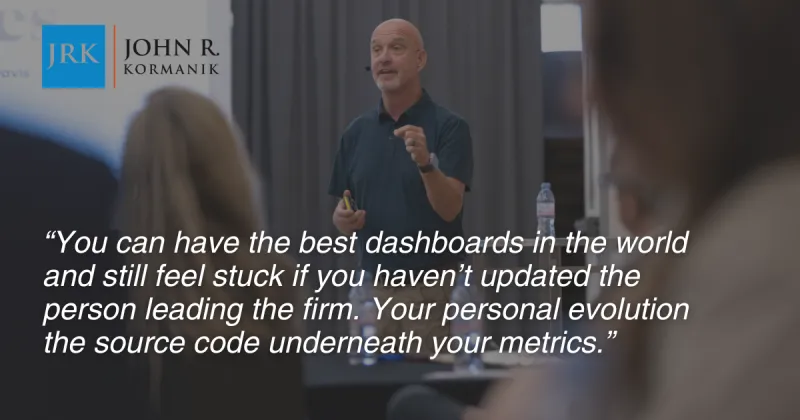
The issue is not effort. It is the founder’s internal operating system.
Most law firm leaders measure everything except the one variable driving all outcomes: their own inner state. When I use that phrase, I am not referring to mood or enthusiasm. I am referring to attitudes, perceptions, and beliefs — the lens through which you interpret situations and make decisions.
That lens determines what you notice, what you tolerate, and what you act on. It shapes behavior. Behavior shapes systems. Systems produce outcomes. Founders understand systems. What they often ignore is the lens that designs them.
When a firm plateaus, the instinct is to adjust external levers: Change compensation, hire differently, implement new metrics, introduce new software, tweak incentives. All of which may be necessary, but if the internal lens remains unchanged, the system will eventually revert to familiar patterns.
Human beings do not sustain behavioral change that conflicts with their underlying beliefs. You cannot redesign the firm without redesigning the founder.
Three outdated beliefs typically cap growth at this stage.
The first is choosing stability over direction. Stability feels responsible. The firm is profitable. The team is functioning. Why introduce risk? The problem is that when stability becomes the default lens, strategic expansion slows. You protect what exists rather than designing what comes next. The firm looks healthy, but its trajectory flattens. Plateau rarely announces itself. It feels like competence. It feels like prudence. It is often neither.
The second is remaining the point of resolution. Early in a firm’s life, everything runs through the founder. That is appropriate when the team is small and capability is limited. It is not appropriate when the firm has grown beyond that stage. Yet many founders continue to serve as the hub of the wheel. Issues route back to them. Decisions escalate upward. Not because the team cannot handle them, but because the founder still equates proximity with quality. The belief is rarely conscious. It manifests as “I’ll just handle it” or “It’s faster if I do it.” Over time, this pattern creates dependency. The team waits. The founder resents being needed. Both are predictable consequences.
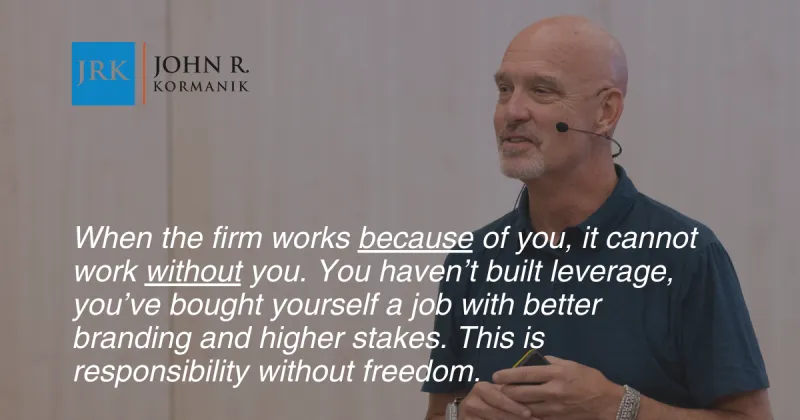
The third is mistaking presence for leadership. Being in the room feels productive. Attending every meeting feels engaged. We confuse visibility with value. At scale, leadership is not measured by how often you are present. It is measured by what no longer requires your presence. If the daily operations of the firm require your constant involvement to maintain momentum, you have built a firm dependent on you rather than a firm capable of operating beyond you.
None of these patterns represent failure. In fact, they likely contributed to your success. They were adaptive at one stage. They are expensive at another.
Competence is often the most expensive trait a founder possesses. When you are highly capable, the firm continues to function even when systems are inefficient. You fill gaps. You resolve friction. You smooth over structural weaknesses. As long as you are present, the system does not feel broken. That is precisely the problem. Your competence hides what should be exposed. It prevents the firm from pressure-testing its own structure.
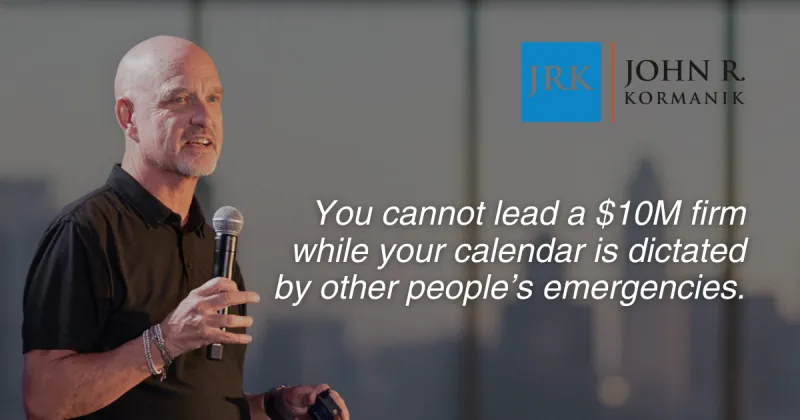
The cost of this dynamic is rarely financial in the short term. It shows up as decision fatigue. Reduced strategic range. A shrinking time horizon. Constant proximity to the work. You cannot operate strategically while standing on the dance floor. Strategy requires distance. It requires range. It requires the capacity to see second- and third-order effects. When you are embedded in daily resolution, your perspective narrows. That narrowing is biological. Under stress and immediacy, the brain optimizes for problem elimination, not long-term architecture.
You cannot be strategic and limited at the same time. Limited does not mean unintelligent. It means constrained by your own internal model of leadership.
At this stage, it is useful to think like a CFO about your leadership. Some attitudes and beliefs are assets. They compound clarity, trust, and decision quality. Others are liabilities. They once drove growth but now require ongoing personal involvement to offset their cost. And then there are silent losses — unexamined assumptions that quietly tax your time, patience, and optionality.
Most founders are not tracking these liabilities. They are not on the KPI dashboard. Yet they affect the firm’s trajectory as surely as any financial metric.
What I observe most frequently is endurance. Founders are enduring their success. The firm is profitable. The founder is respected. But the business requires constant personal oversight to sustain its performance. That is not design. That is effort-based leadership.
Endurance asks, “How do I keep this working?” Design asks, “What must be true so this works without me?”
That is the shift: From managing outcomes to architecting conditions. From managing partner to architect of the enterprise. When leadership becomes architectural rather than reactive, the experience changes. It becomes intentional rather than exhausting.
There is one question that cuts through the noise: What is this costing me that I am not accounting for?
Not just in dollars but in decision quality, in strategic patience, in optionality, in time horizon, in the psychological bandwidth required to think beyond next quarter.
When outdated beliefs remain unexamined, the firm continues to function but at a premium you never consciously agreed to pay.
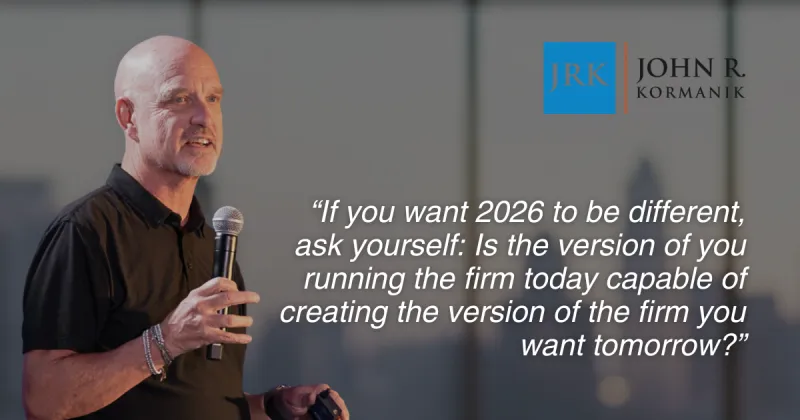
If you want the firm to scale beyond your personal capacity, the work is not first operational. It is internal. The founder’s lens determines the firm’s ceiling. Until that lens evolves, growth will eventually compress against it.
Nothing is broken, but something is no longer scaling.
That distinction matters.