Inspired by my Kenyan safari, “Field Notes” are my observations from the field where my clients and I work: coaching sessions. Each field note is drawn from actual client sessions and gives insight into the personal evolution of my clients.
Location: A Personal Injury Firm Founder’s Office, United States.
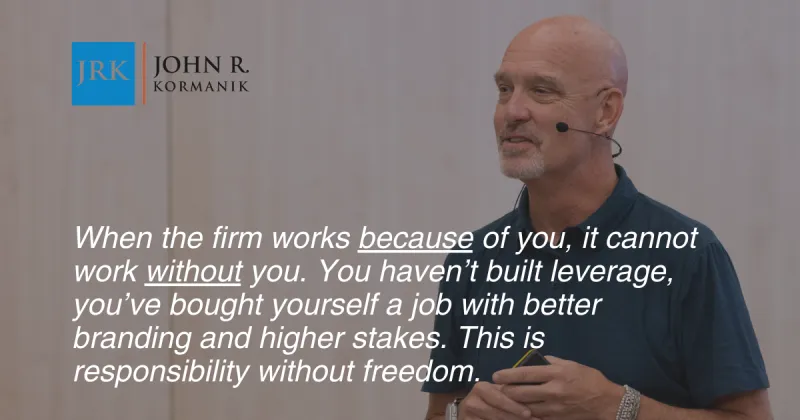
Observation: When your team performs because you are in the room, you have built a dependency, not a system.
My client opened with a win, and it was a real one. His team now had complete clarity on what he needed from them in the final stretch of the year, because he had repeated the message in every all-staff meeting until no one could miss it. Each person in litigation had a defined role, a short list of priority matters, and a weekly check-in. By any ordinary measure, he was leading well.
So I gave him a question to carry rather than answer on the spot. The teams are acting because you are there and because this is your priority, so how does that become simply the way the firm works, with you not having to be there?
1. The Sustainability Test
He did not flinch, which told me he had been asking it of himself. This was not the model he wanted, he said, and if this level of personal energy was what the firm required, that was a problem. He wanted to be able to take two or three weeks with no contact and have things keep going. He had also been fielding unsolicited inquiries from outside buyers, and he understood that any serious buyer looks first for a firm that does not run through its founder. The market was already telling him what his own instincts were telling him.
2. The Grip on the Steering Wheel
What struck me was that he had been doing the right architectural work. He had been simplifying procedures and building accountability into each one: who is responsible, and who backs them up when that person is out. He called it the best use of his time, and he was right. But when litigation struggled, financial pressure pulled him back into a reactive space, and the old habits came with it.
We named it plainly. In Energy Leadership terms, that is Level 2: I win, I am focused on survival, and I am not focused on the machine running itself. It is not a character flaw. It is a predictable response to the bank account, and it carries a cost. As long as both hands are on the wheel, the firm never gets the chance to learn to drive.
3. The Consequence He Hadn’t Considered
He gave me a useful example without realizing it. He had been about to roll out a system reconfiguration, then stopped because his team would have had to learn it in the busiest weeks of the year and then learn a replacement a few months later. That was second-level thinking, and it saved his people real pain. I asked how consistently he applied it at the front end of an idea, and his honest answer was “decent.”
That matters more than it sounds. A founder who consumes a great deal and generates ideas constantly is also, even with good ideas, a source of churn and friction for his team. A firm with systemic integrity absorbs change on a schedule and through a structure, not whenever the founder gets excited.
4. What the Upgraded Architecture Asks of Him
He already protected a No Contact Wednesday, and I pushed him to go further inside the pressure. Take fifteen, thirty, forty-five minutes to think at the visionary level, even in a season that feels like survival. A leader can be the person who gets things done under stress and also the person who designs the game. If he waits for the pressure to lift before he thinks big, he will arrive in January with everything ready and three months lost.
His takeaway was to hold his North Star on leading the firm rather than managing it, and to remember that survival mode and long-term thinking are not sequential. The calendar keeps moving whether or not he has loosened his grip.
The Bottom Line
A firm that performs only while its founder is watching has not yet been built. It has been borrowed against the founder’s energy. The standards, decision rights, and accountability structures he is writing are the real asset, and the pressure that makes him want to grab the wheel is exactly what delays the moment they start carrying the load.
Field Exercise
One. If you disappeared for two weeks with no contact, what specifically would stall, and what does that tell you about where your presence is holding the structure up?
Two. When pressure rises, which old habit pulls you back into doing instead of designing, and what is it protecting you from?
Three. What fifteen minutes of visionary thinking can you protect this week, before the firm feels ready for you to take it?
The founder who answers those honestly is the founder building a firm that holds when he is not in the room.
End of dispatch.
Ready to build a firm that runs without you holding the wheel? Schedule a 1:1 conversation with me.